Leaving Rawdon & the Status Quo

I suppose you don't really appreciate a person or place as much as when you are leaving them. This was very indicative of the way I felt after deciding to up sticks and travel the world. This was something I had often dreamed about, had been saving for, but not yet had the balls to actually go ahead and do it. The fact that I had been made redundant after seventeen years of taking the easy option of adhering to the status quo was the kick up the arse that was needed. But quite scary as well!

I had been on many walks around northern Leeds last summer and was amazed by how little time it takes to get from my front door into the countryside. The River Aire is 15 minutes away and the Billing 10 minutes, where one can get panoramic views of Leeds and Ferrybridge power station to the south and east (above), and Ilkley Moor and surrounding moors to the north and west.
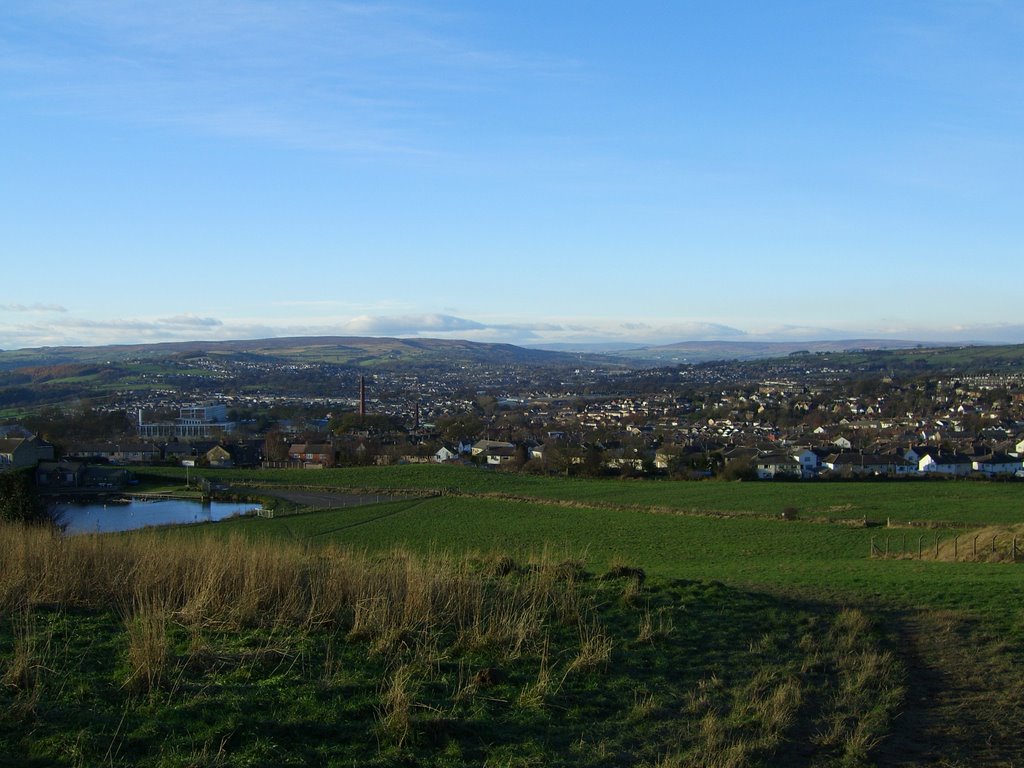
The view from the Billing over Rawdon towards Ilkley Moor and Haworth. The sunsets here were always sensational. I'm going to miss living on the side of a hill in Yorkshire - but the world awaits!
 One of the glorious sunsets from my bedroom window!

If you would like to leave a comment or contact me, please click on the comments link below.
Hawick & Great Bike Racers
 (the old red eye reduction catches them every time!)
I started my foray into the beautiful country north of the border with a visit to my old mate Chris. He lives in Hawick, which is a handy first stop being slap bang in the centre of the Scottish borders, and Chris likes to drink lots of beer like I do!
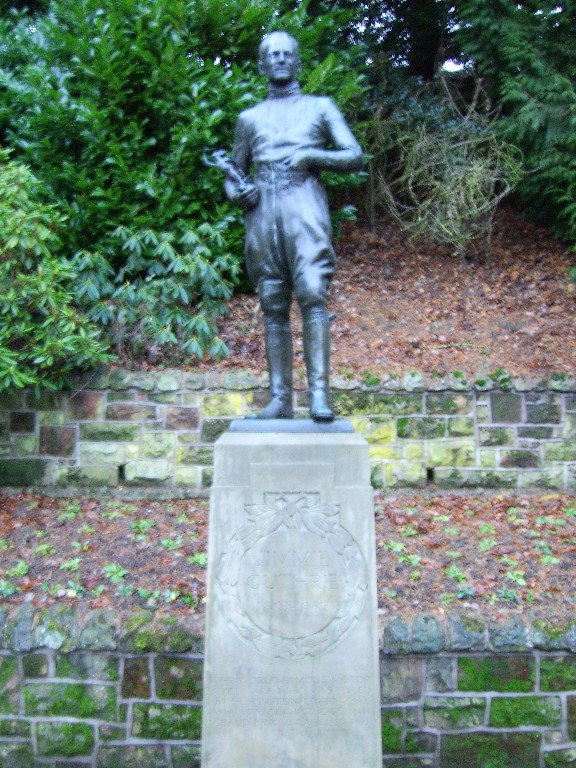 Hawick's most famous son of years gone by was Jimmie Guthrie. Born there in 1897 he started as a dispatch rider in France during the great war and joined Hawick Motorcycle Club on returning. They entered him into his first TT in 1923 and the rest is history, as they say.
This statue was erected in his honour in Wilton Lodge Park by the river in Hawick next to the museum where there is an exhibition featuring some of his race bikes and trophies. There is a list of his major wins in TT, Northern Island road races and countless 350 and 500cc GP`s and six titles in Europe - nearly 50 wins in all! Sadly, he fatally crashed whilst leading the European GP in Germany at the age of 40. The funeral procession in Hawick stretched for three miles. There are other memorials to Jimmie Guthrie: the Guthrie Stone at the Sachsenring, where he died, and another at the roadside spot, The Cutting, where he retired in his last Senior TT.
Another great motorcycle racer from Hawick, and one closer to my heart, was Steve Hislop. Sadly taken from his family and all bike racing fans in a freak helicopter crash, which has still not been adequately investigated in many people's eyes. Steve was one of the fastest superbike riders in the world. When he was on the pace and riding top level machinery he was unbeatable.
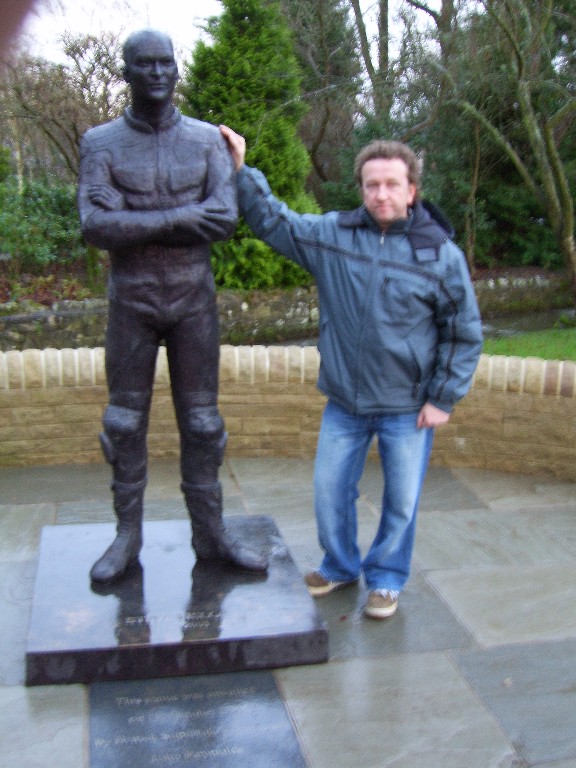 He won 11 Isle of Man TT titles, 3 North West 200s and Macau GPs, the Ulster GP, Le Mans and Bol D'Or 24 hour races and was British 250cc champion and British Superbike champion twice. In 1989 Steve became the first rider to top 120 mph with a TT lap at 121.34. This record was beaten 3 years later by WSB champion Carl Fogarty, but he would still only come second to Hislop who was riding a rotary Norton in that race. Foggy's record was to stand for 8 years until finally bettered by David Jefferies in 2000.
Steve was truly a great man who I still miss on the racetrack.
This life-sized bronze statue stands in the park at Hawick, and another identical one has been erected in the Isle of Man.
If you would like to leave a comment or contact me, please click on the comments link below.
Kingussie and Dunnet Head
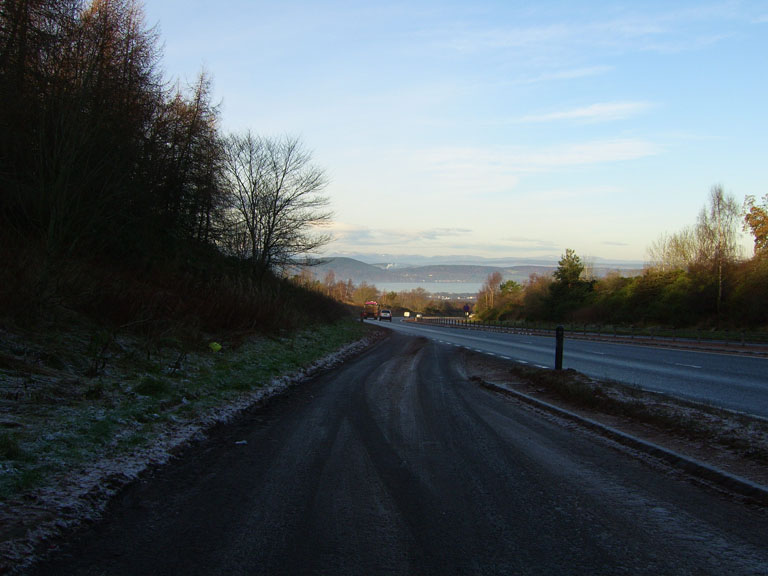
I decided it was time to stop when about half way to Thurso from Hawick and ended up in a nice little town on the A86 called Kingussie. It is close to Aviemore and therefore a popular place to stay for winter sports fans.
My philosophy on finding good, reasonably-priced accommodation is quite simple - find a local pub that's open, go in and have a pint or a shot of the local brew (if possible) and, once you've been in there for a while, try to strike up a conversation with one of the locals or a member of the bar staff, or landlord, and ask where you can find the type of room you require.
This method has never failed for me, it beats tourist information and even the internet hands down. In Kingussie I went for a pint in the Star Hotel on the High Street and got chatting to a local customer who directed me past the more expensive hotels to The Silverfjord Hotel on Ruthven Road near the railway station. As well as the restaurant and bar, there is a small public bar at the hotel with very friendly locals where I enjoyed a couple of local brews. The room was decent, large, with en suite and TV for the princely sum of 27.50 sterling. I actually dined at the Star Hotel and the food was excellent. The next day was nice and sunny - perfect for the 200 or so miles drive I had to the top of the country. What beautiful scenery it was too. The Cromarty Firth bridge was the highlight of the trip, being over a mile long with stopping places and fantastic views both inland and towards the sea and, as you can see above, the weather can be good in Scotland in December!
 The view from the bridge looking inland towards Urquhart.
There was even an oil rig in the firth (see above, you can't quite see the sea as the firth bends around to the right, but the rig is to the right).
The drive to Thurso was quite long and, as I'm no early riser anyway and we're talking about a British Winter where it goes dark in the afternoon, nightfall was approaching as I drove along the deserted headland to Dunnet Head. The only other signs of life of any kind were the Highland cattle grazing on the moorland.
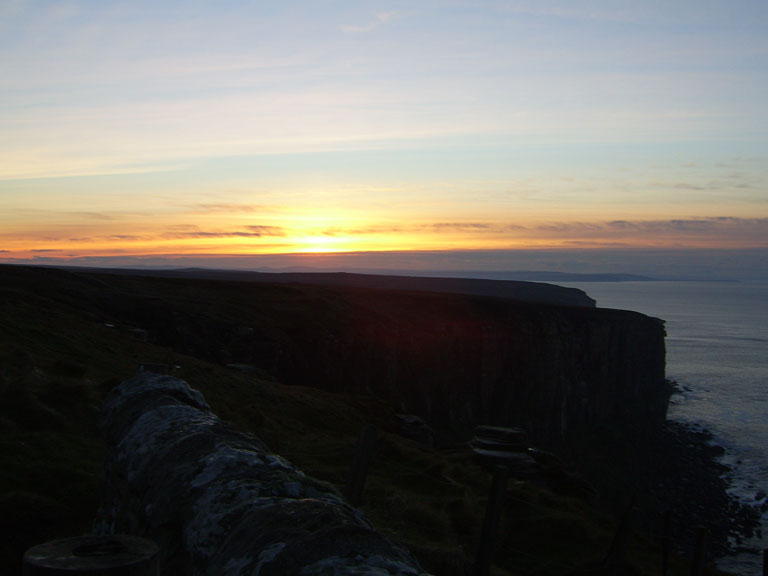 Looking south-west over the cliffs towards the bay at Thurso.
There is a light house on the cliff (behind me in the above picture) which is some 105 meters above the sea, yet in stormy weather water and stones still splash over the top of these cliffs!
The previous night in Kingussie I had been recommended to stay in Wick rather than the more obvious choice of Thurso. Using the trusted "Johnny" method of finding accommodation, I found somewhere to park near the harbour and then went into the nearest pub - Sinclairs on The Shore. It was a little on the rough side, but the staff were friendly and sent me to a cheap B&B overlooking the sea. Unfortunately the place was full but the lady there directed me to another place just above. This was true British Bed and Breakfast as it was just a room in somebody's house - felt a bit strange really but I was on a budget and just wanted to get something to eat and drink lots of beer!
I ended up having a "curry and a drink" special at the JD Wetherspoon pub in the market square. I don't usually go for chain pub food, but this was very nice actually (although they are prepared surprisingly quickly...). After several more drinks I ended up in a bar in the early hours where, as nearly everywhere in Scotland, I was warmly welcomed as a foreigner. I asked if there was a good local malt and was given an enormous measure which would have put a Spanish barman to shame! They wouldn't let me put water or ice in it though. After a couple of these the next thing I remember is waking up in somebody's house (my B&B) - hope I didn't make too much noise when I staggered back in!
After forcing the obligatory breakfast down the next day I headed south towards my only other fixed destination which was Ballachullish where my Mum had spent two summers in the 1940's when a schoolgirl with my uncle Ken and auntie Maureen, as he was working there as a scientist, I think at a plastics place in Kinlochleven. I also planned to stop somewhere else, probably Loch Lomond on the way back to England.
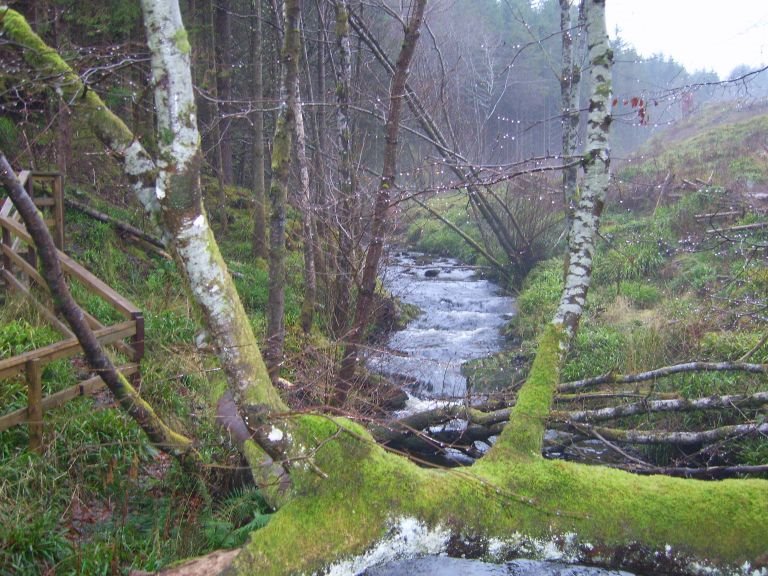
As I drove down the north-east coast I decided to stop for a walk in an area called Skelbo Wood near Durnoch just off the A9. There is a path which runs down to Skelbo Burn(above) with some fine old trees as well as the more common young broadleaves planted by the Scottish Forestry Commission to be their successors. The only wildlife I saw, though, were the carved wooden animals designed by local children which are dotted around the path!
 After taking the above picture, the path continued back into the forest and I came to a crossroads with no markings. Thinking I knew roughly what direction my car was I decided to turn left at the crossroads. This must have been the wrong way as I got totally lost and ended up veering off the track to take a "short cut" through the trees in the direction I thought the car park would be. Eventually I came to a fence, so had to re-trace my steps to return to the track I had been on. It was quite bad underfoot with big clumps of grass - sometimes with previously fallen trees underneath, so I had to be very careful as breaking my ankle "off the beaten track" like this could have been very dodgy - especially as I had no signal on my mobile. Boy, was I relieved when I eventually saw my car!

The car park and my car, phew! You can just about make it out hiding in the trees (I had to brighten the photo though), not the most obvious car park in the world!
If you would like to leave a comment or contact me, please click on the comments link below.
Drumnadrochit & Glencoe

The bar stocks excellent real ales from the highlands, usually with at least one Isle of Skye brew which is lovely stuff. The Benleva was voted the CAMRA Highlands & Islands Pub of the Year 2005, for the second time in three years. The owners started having an annual beer festival a few years ago and this is now the largest in the Highlands, boasting over 50 cask conditioned ales and ciders last year. The next one is 22 to 30 September 2006 and I hope to be there if I'm in the UK then. The bar meals are delicious as well, ranging from traditional Scots fayre to more fancy stuff. You get a very friendly welcome from the hotel owners Allan, Steve and James. Brothers Allan and Steve are normally behind the bar and James, the chef, creating culinary delights in the kitchen. I enjoyed my stay here more than any other hotel I can remember.
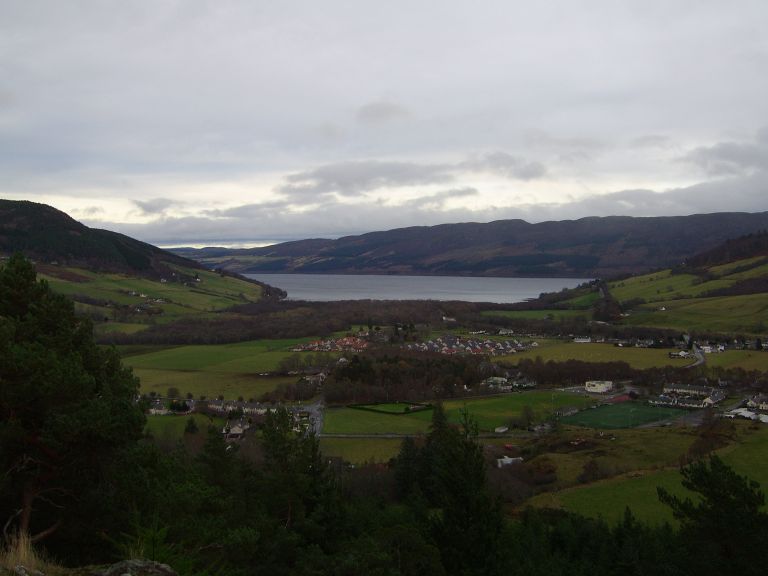
There are three 'proper' pubs in the village including The Benleva and they are collectively known locally as "The Triangle". The other two are the Smiddy Bar and the Blarmor Sports Bar. The Sports Bar generally opens later and has a disco at weekends. It was at this disco that I met an Australian guy called Paul who works in Edinburgh. He was partying at Loch Ness for a holiday with his mates and we had a right good laugh - G'day Mondzy!
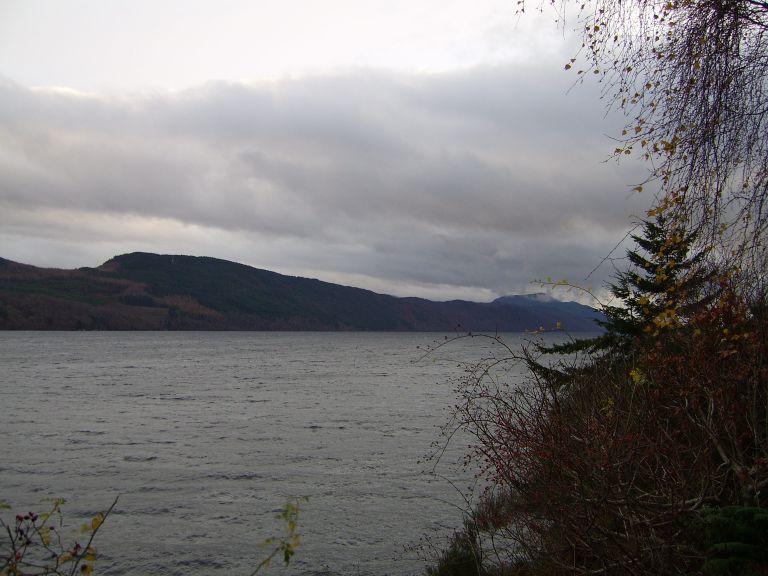 I actually saw the Loch Ness Monster whilst driving along the loch one day, but it had just gone back under the water by the time I could stop and take this picture - darn it!
I enjoyed my time here so much that I decided to stay for the rest of my Scottish trip and not stay in Ballachullish or at Loch Lomond as I had intended to do. I did drive past the invisible Ben Nevis (hidden in the clouds for 9 days out of 10 at this time of year) and had a look where Mum used to stay in Ballachullish and parked up at Kinlochleven to go for a walk in the mountains. The walk starts on part of the West Highland Way and quickly climbs up the north side of Loch Leven.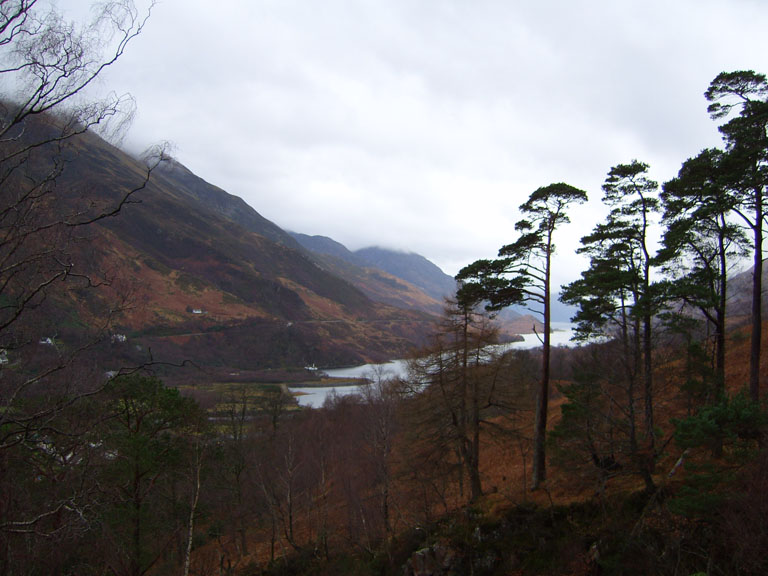 Looking down Loch Leven towards Ballachullish with the Pap of Glencoe to the left.
I had to stop a few times on the way up to look after the old 'ticker' as I wasn't very fit - and look what happened to Robin Cook!

After climbing about 2,000 feet I saw 'Am Bodach' up ahead which rises to 1,005 meters. I decided at this point that the distance I had already climbed was enough!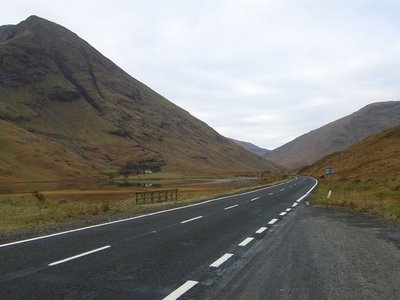
Glencoe - the glen of tranquillity - apart from the A82! A pleasurable drive in the western highlands. It made me forget I still had over 400 miles to drive!

Just couldn't resist a quick stop for chill and photo of Loch Lomond.
If you would like to leave a comment or contact me, please click on the comments link below.
Ferry, Logroño & Bike Breakdown
 Nick Sanders, eat your heart out! Traveling light is not my bag!
Nick Sanders being a famous biker who has toured probably everywhere, certainly around the world a few times - and without all the backup vehicles and people that Ewan McGregor and Charley Borman had in "The Long Way Round" either. He states on his web site that you should take as little stuff as possible - ahem, sorry Nick.
As my tour is for several months and I am also carrying hiking gear and a tent, sleeping bag, air bed and pillow, I don't think I've done that bad. Three pairs of jeans and more than a week's worth of clothes isn't too over the top is it?

The Ferry, Portsmouth to Bilbao, 9th June 2006
The ferry to Spain was, as all ferries I seem to have been on in the past, a very drunken affair, and the first two-night voyage I've been on. Once the ferry sets sail and leaves Britain's shores, then that marks the start of most people's holiday, so "let's get the party started". I met a very funny guy called Pete on the first night at the bar who ended up buying shorts for me and a Scottish bloke I had just met. Pete and his mates were driving down to Portugal in a van, for the craic! (they actually made it.... well 30kms into Portugal then had to turn around to make the ferry which they did with 15 mins to spare - good lads!) On the next day I just had time to grab a cornish pasty and a Stella from the bar before watching England's first game in the world cup. I got talking to David, who has done more travelling than I've had hot dinners. He and his wife, Stella, have a 'business' card with a globe and tropical island type logo describing them as "new age pensioners. Experts in caravanning, golf & generally loafing around". We proceeded to have a conversation about world travel which turned out to be far more interesting than England's debut against Paraguay. Then met Pete and his mates again out on the deck and got hammered!
Bilbao, 11th June 2006
Sunday morning was an early start, hungover and hot after carrying all my luggage down to the bike and venturing into Spain. Motorcycle leathers aren't ideal for comfort when it's hot! Managed to find an open petrol station near Bilbao eventually and cooled off with a snack and cold drink.
I don't have any fixed destination in Spain at all, except that I want to keep to the north during the hottest months of summer. However, some friends of mine, now living in the Bay Area near San Francisco, know a guy who is currently living in Barcelona and working for a MotoGP team (Pramac d'Antin Ducati), so I decided to head there as the Catalunian MotoGP races were on there the following weekend. I had a look at my map and decided that Logroño would be a good place to stop for the first night as I felt too rough and hot to do any major mileage.
Logroño
Remember the "Johnny" method for finding the best, most reasonably priced accommodation by asking in a bar - well it failed miserably in Logroño. I was directed to a four star hotel that was €80 a night! I told the person there that this was too much and asked for a cheaper hotel. He directed me to a three star hotel nearby and I was that hot and knackered that I decided to stay there. The room was large and air conditioned though which was a welcome relief. This was my first night in Spain, so I hadn't got the knack or sufficient Spanish to do any better. I should have used my "Rough Guide" book.
Once out and about in the city I soon came to realise that nobody speaks English and that my night school Spanish was not good enough at all to get myself understood! I also got lost whilst wandering around looking for something to eat and ended up aimlessly wandering the streets for some time. Therefore my impression of Logroño was not very good, I'm afraid. I'm sure it's a lovely place and I may return there for a proper look around during my travels. As it was, I couldn't wait to leave the next morning. I looked at the map and decided to stop at Zaragoza as that was roughly half way to Barcelona and I wasn't in a rush. This time I looked at the Rough Guide and picked a pension that was cheap near the centre of the city, so had a definite destination!
Major Bike Problems, 12th June 2006
I was on the way to Zaragoza on a reasonable 'A' road and feeling quite good on the bike and not too hot, taking it easy on less than half revs at about 70mph when there was suddenly an almighty loud clattering noise which I could hear easily above the wind noise and sound of the bike's exhaust. I had done 31 miles from Logroño and I'd thrown a valve, or something major anyway! I pulled off the road as soon as I could and found some shade outside a Mitsubishi dealers. I couldn't get the guy to understand that I wanted to use his phone to call my breakdown insurers (glad I took European cover out before leaving!), and felt a bit cheeky so managed to get a card off him with the address on it so I could tell them where I was.
The bike had had a major service the week
 before leaving and the mechanic had said he had 'tapped' the cam chain tensioners in to tighten the chains but they would possibly need replacing at the next service, so I wondered if that had caused the problem as my bike had only done 18,000 miles and it is a Honda after all! I'd never had any problem with it before even when pushing it to the limit on track days in hot weather (apart from warped front brake discs which Honda replaced for free even though the bike was out of warranty), but as soon as I really needed to rely on it this happens! Bolas!
This was the third disaster in three weeks with my bike:-
The day before I left my last address to see friends around England before the ferry, a van reversed into my bike and knocked it onto a fence. This caused only cosmetic damage, but to get it repaired in insurance terms would cost nearly 1,000 pounds. The guy took my phone number but never rang me - you know who you are, Jed!
The following evening I finally emptied the house and left to head down to my mate's in Kettering. I had only gone a few miles and was on the M62 when the back end of the bike started weaving around. At first I thought it was all my luggage and the wind and the fact I wasn't used motorways as I hadn't ridden the bike properly for months, but it got much worse and by the time I'd pulled onto the hard shoulder the rear tyre was completely flat! I was already stressed out and just thought "can things get much worse than this". I had thought it would be wise to take European wide breakdown cover insurance for the foreign trip with my bike insurer, but this didn't come into effect until the renewal date of my bike insurance - two days later!
I was stood there on the hard shoulder on a dark Sunday night holding my bike up as it wouldn't lean over sufficiently onto the side stand with the flat tyre and all the luggage. I racked my mind on who I might call and phoned my brother, Steve, for advice. I was then trying to phone whoever may be storing my insurance phone number details to see if they could at least organise a truck to pick me up, when another biker passed and stopped further up the hard shoulder. I thought "what help can he be with a punctured tyre". I had rearranged the luggage by now to be hanging over one side and the bike would just about stand up on it's own, so I ran up to the bike as the guy was getting off. I explained what had happened and he proceeded to open one of the fixed panniers on his BMW and produced a puncture repair kit! I can't quite explain my feelings at this moment, but you could probably envisage them. I didn't know such things existed, but there was a little tool to roughen up the hole after removing the object (screw in this case) then a rubber bung and some glue to fix it in with. Then 2 small canisters to get just enough pressure into the tyre to drive (very slowly) to a garage to blow it back up to the correct pressure.
My "Good Samaritan" then followed me all the way to a garage with his hazard flashers on (I've forgotten this saint-like biker's name sadly - he gave me his email which I can't find now in Spain - I think he was from Lincoln). I now think BMW's are cool - what other manufacturer would put hazard flashers on a motorcycle? I then continued down to Kettering at an extremely frustrating 45mph and was only about three hours late in the end.
Back in Spain I was waiting in the shade in Calahorra for the breakdown truck which arrived within an hour of me calling my insurers in England. Well done to CIS, with whom I have had my bike insurance for many years (I had a bike stolen several years ago and got very good service then also). Of course, the mechanic couldn't speak English but he also thought the clattering noise was a "válvula" hitting a "pistón". We loaded the bike onto the truck and I asked the Spanish telephone operator by phone if we could go to Zaragoza as that was my destination. We couldn't do this so we proceeded to head back to Logroño! However, once there the breakdown guy phoned the Honda dealers and they were shut as there was a fiesta about to start! So we had no choice but to head for Zaragoza after all.
We got to Zaragoza about 7.30 and unloaded the bike at the Honda dealer. I was told that they would strip the engine and should know what the problem is by eleven o'clock the next morning. Fingers crossed, eh!
If you would like to leave a comment or contact me, please click on the comments link below.
Zaragoza, History and Bike News
The taxi from the Honda dealer seemed to take ages, as there are many road works in Zaragoza (English name Saragossa). Then the driver couldn't actually drive right to my guesthouse, so I had to carry all my luggage and leathers quite a way and up some stairs to reach it. I was also on the third floor, so was knackered when I got to my room. The room was very clean and a bargain at €20 a night. The bathroom and toilet were shared, but that first shower was priceless. I went out to find a bar nearby, and though it was called "Harry McNamara's Bar", yet again no English was spoken there.
Feeling a bit down about the bike troubles and not being able to speak to anyone, I began to think that Zaragoza would be another Logroño-type experience, only in a bigger city, and I'd be just as glad to leave there, when I rounded a corner heading towards the central plaza, or square, and was greeted with the street view below.
 This is Calle Alfonso I which leads to the city's central plaza and straight ahead is one of the towers of the Basilica de Nuestra Señora Del Pilar. My spirits lifted immediately and I thought "this is more like I expected".
The Basilica is on the north side of the Plaza del Pilar, an amazing square which was paved in brilliant pale stone when remodelled in 1991. It is about 500m long and gives a sensation of great spaciousness.
 View to the east in the Plaza del Pilar.
Every major epoch in the city's development is covered around the square. The city was founded in 24 B.C. by the Romans on the site of an ancient Iberian fortified town on the banks of the River Ebro. It was named Caesaraugusta in honour of its founder Emperor Caesar Augustus. It was surrounded by a rectangular wall with four gates. These walls were up to seven metres thick in many places, the outer part consisting of alabaster and limestone, the inside mortar being amazingly hard (opus caementicum). Roman wall ruins at the western end of the Plaza del Pilar (thanks to my roving Kiwi photographer Sean for the picture).
At the east end is the old cathedral, La Seo, which was extensively restored a few years ago.
In A.D. 714 the city was conquered by the Muslims, a fate which would befall nearly the whole of Spain, and became known as Saraqusta.
In A.D.1118 it was captured by the troops of Alfonso I, the Battler, and become the capital of the Kingdom of Aragon. The cathedral was built shortly after, hence the Gothic-Mudéjar style, a combination of architectural design and materials used under centuries of Muslim rule, and later superimposed Christian Gothic.By far the most amazing building in the plaza is the Basilica of Nuestra Señora del Pilar. This Baroque masterpiece is one of Spain's greatest and most revered religious buildings and one of the most important sanctuaries devoted to the Virgin Mary in the Catholic world.It flanks the River Ebro's southern bank in majestic style.

According to an ancient tradition, prior to her death the Virgin Mary came from Jerusalem on the night of 2nd January A.D. 40 to visit the Apostle Saint James, who was preaching the gospel to early converts on the banks of the River Ebro. The official i/DN tourist guide to Zaragoza says she came and brought the Pilar ('pillar' or 'column') with her, on top of which was to be built the first chapel. Other guides say that she descended from heaven as an apparition on top of the Pilar.
Whichever version you subscribe to, if either, today the original Pilar, topped by an image of the Virgin, is constantly surrounded by pilgrims who line up to touch an exposed section. Over the centuries several temples have been built here since the original one, but the current Basilica was designed and built in the 17th century when the cult of the Virgin del Pilar reached dramatic popularity.
Apologies for all the tourist stuff, but this city has so much history right in the centre that I had to give a potted version of it to do it justice.
A small charge gets you by lift to the top of one of the towers of the Basilica, from where there are some great views of the building itself and over the whole city. I didn't go up myself, but thanks to Sean for the photos below.
 View to the east with the River Ebro.
  View to the south from the Basilica tower.
Apart from the Plaza, the other main attraction of note is the Aljaferia, which was built in the middle of the eleventh century in the heyday of the rule of an independent Moorish dynasty, the Ben Kasim, thus predating the Alhambra in Granada.

The next day was "the day of reckoning", when I would find out just how much damage had been done to my motorcycle. I went to the Honda dealer expecting mucho expense and time to work on the engine. On arriving there, I was taken into the workshop by the mechanic, who could speak a little English, and was shown the front cylinder's cam chain tensioner, whose spring had disappeared (disintegrated, I hope, and not somewhere in the engine). So the noise I had heard was the cam chain rattling, but there was no evidence of damage to the rest of the engine. The repairs would simply be two new cam chain tensioners, as the rear one could be suspect too. Excellent news compared to how bad it could have been. They said I could pick the bike up the following evening if the parts arrived on time. Marvellous!
If you would like to leave a comment or contact me, please click on the comments link below.
Zaragoza, Pablo Gargallo
I was greeted by some of Pablo's horse sculptures which immediately caught my eye and whetted my appetite for more.
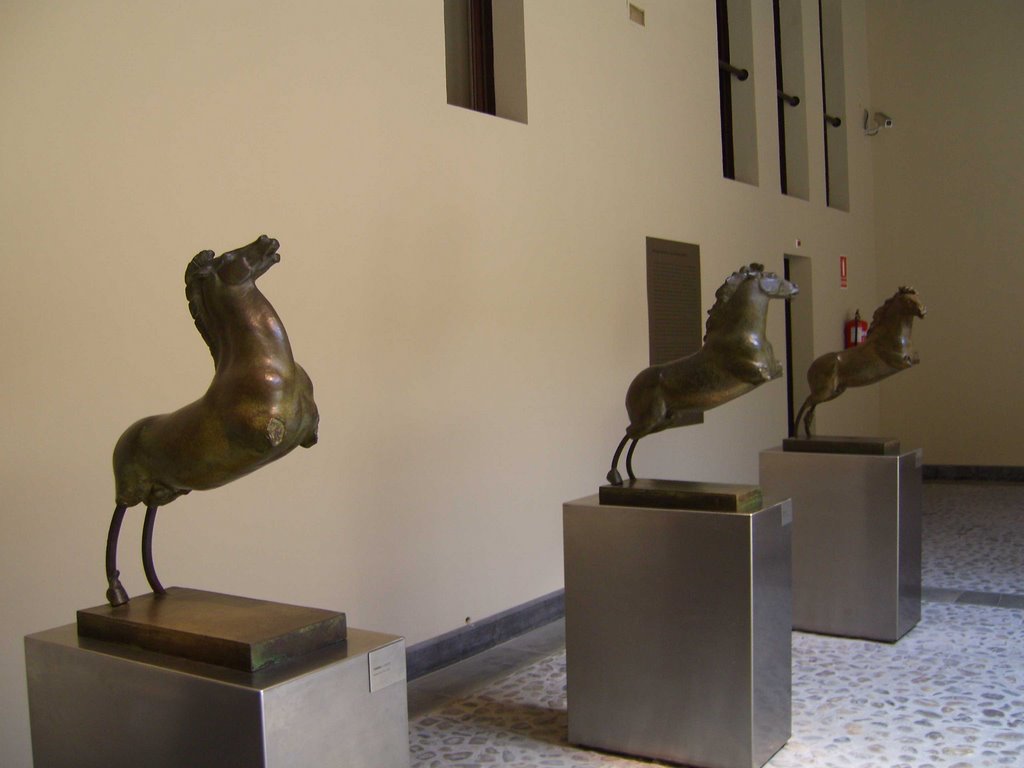
3 of Pablo's "Horse" sculptures, 1927-28
The sculptures were excellent and Gargallo, a good mate of Picasso, is considered to be one of the most significant artists of the Catalan avant-garde and the master of cubist sculpture working with iron.
Pablo Emilio Gargallo Catalan was born on January 5th, 1881, in the town of Maella in the province of Zaragoza (Aragon). His father owned a blacksmith's which was a good start to working with metal. His family moved to Barcelona and in 1895 he entered the studio of Eusebi Arnau i Mascort (great name, eh?) as an apprentice. From 1900 he frequented the "Els Quatre Gats" cafe for literary gatherings with the likes of Picasso, Nonell and Canais. He later moved to Paris, taught in Barcelona until getting sacked for political reasons before setting up permanent residence in Paris. Here he made large pieces out of thick metal. He created sculptures for the Montjuich Olympic Stadium and the 1929 World's Fair in Barcelona and other events in New York.

Urano, 1933.
Urano is my favourite of those on display. I have seen a few photographs of it, but they all look dull, including the one in the museum pamphlet. They look more iron than bronze.
In addition to traditional sculpting methods, Pablo developed a style of sculpture based on the creation of 3 dimensional objects from pieces of flat metal plate using paper or cardboard cutouts for his designs, many of which can be seen at the museum. He contributed to the renewal in european sculpture by working with new materials like lead, copper and iron and created a new sculptural language by presenting empty space or void as a kind of volume.
In 1934 Gargallo put on very successful exhibitions in New York and Barcelona but then unfortunately suffered from a sudden fulminating bronchial pneumonia, causing an early death at the age of 53.
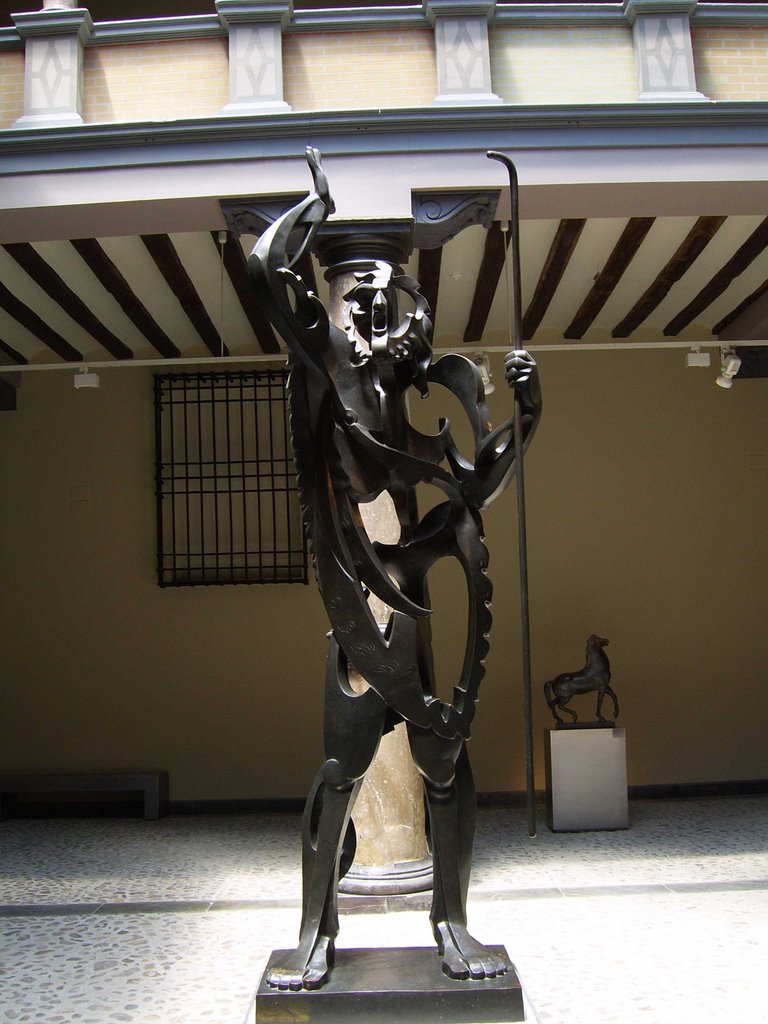
The Prophet (St. John the Baptist), 1933
Next post coming soon, "Zaragoza When the Sun Goes Down".
If you would like to leave a comment or contact me, please click on the comments link below.
Zaragoza When the Sun Goes Down
 I don't think I need an excuse for another picture of the Basilica de Nuestro Señora del Pilar, so here's one of the sun setting over the Rio Ebro.
This river winds all the way across Spain to the mediterranean from it's source in the Basque country, a large lake called the Embalse del Ebro in the aptly named Pico de los Tres Mares (peak of three seas), only about 70 kilometres south of Santander on the Atlantic coast. It is the longest river in Spain and it is believed that the ancient Greek name for this river was "Iberus", which was first documented in the 6th century BC by a Greek author in reference to the Iberians, or the people who lived along the Iberus river.
Ultimately the word may well derive from the Basque words ibai (river) and ibar (valley), and also from ur meaning water. Linguists have noted similarities with the names of 200 other European rivers and streams (such as Ibar in Serbia, Ebrach and several Eberbach in Germany, Irwell in The UK), suggesting that a form of Basque was once spoken throughout Europe before the arrival of Indo-European tribes and languages. I will cover this, and recent genetic studies from Oxford university pointing to Basque origins of British people, in my forthcoming posts about the marvelous Basque country (where I ended up staying for four months on my "travels"!).
 Plaza del Justicia, a great place to sit and relax in the cool of night
I had no memory that this, and another picture of the guy at the front, had been taken. I had run into these youngsters several times on the way home from a night out and they would practice their english on me (poor sods). On this night I had my camera attached to my belt as I'd been out since the afternoon, so that would explain it then!
 Zaragoza is going through a massive building and restoration programme ahead of hosting the World Expo in 2008 which, appropriately enough for this desert region, is entitled “Water and Sustainable Development”. Most of Spain is short of water and in Zaragoza there have been ideas put forward to drain the old canal, whereas in Valencia (where I am now) they are working on a desalination project.
As a result of this the traffic is even worse than other Spanish cities, and hundreds of local police can be seen waving their arms and blowing their whistles in an almost impossible attempt to keep vehicles moving at rush hour. There are also many temporary walls around building sites, and the like, where the local graffitists soon get to work. I have included just a couple of examples on a wall around the corner from my pension. It certainly beats the stuff at home!

If you would like to leave a comment or contact me, please click on the comments link below.
Spain 5, Zaragoza Bars 1

The first bar I made my local was Harry Macnamara's on calle Mendez Nuñez which was just around the corner from my hotel. They do a decent "desayuno" (breakfast) deal consisting of juice, toast with butter and marmalade, and coffee for €2.25. They keep serving this into the afternoon which is handy for late-night revellers like myself! The staff here are very friendly, but you need to be able to speak some castellano (spanish) in order to get what you want. Watch out for my future blog, "English Idiot Guide to Spanish" to find why it is better to refer to the spanish language as castellano, rather than español, when in Spain.

Despite the bar's name and the above logo, it is a spanish bar. The only scottish touch being a tartan tammie and scarf on the spanish beer pump! Apparently the barmaids used to wear short tartan skirts but, alas not any more. However, here's how it might have looked if I'd have been there in 2004.......

The local beer here is Ambar, which you can get on draught in this bar. It's brewed in Zaragoza and quite nice.
Nobody spoke english in the bar so it was a bit of a challenge to order anything other than wine or beer, even when I asked for a "café con leche", I got blank looks. Pronunciation is the key thing here, and mine wasn't good enough at this stage. I met one guy, Joaquín, who could speak english and he "took me under his wing" and tried to help me learn.
Joaquín with tammie!
 He drank a lot of a spanish liqueur called Pacharán. It's very popular in Spain and very nice, if a little sweet. It originated in Navarra in the Basque Country as a home-made drink(it's Basque name is Patxaran). When I was later in Vitoria-Gasteiz and took a basque girl out on my bike, we were walking in the country and came across some blackthorn bushes, she immediately started fervently picking the sloe berries so she could make some Patxaran. It is made by soaking the berries in anisette, with a few coffee beans and a vanilla pod, for several months.
Joaquín shattered my illusions of being able to speak spanish fluently within a few months, and told me it would take a couple of years! I now reckon he was right too.
The bar has a big screen for major sports events, which was handy as the world cup was on when I was there. The relaxed atmosphere meant it was the place where I would watch several games, particularly when Spain or a south american team were playing. As for England games, see my next posts on "Irish" bars in Zaragoza, where ex-pats and native english speakers are normally to be found.
An extra treat for any fans of the cult Australian drama "Prisoner Cell Block H" out there, the lady who runs the bar is a dead ringer for Miss Ferguson!
If you would like to leave a comment or contact me, please click on the comments link below.
Spain 6, Zaragoza Irish Bars
 The first Irish bar I found is on calle Alfonso II, close to the central Plaza Del Pilar. Flaherty's is one of a family-run chain of 4 pubs in Spain, the others being in Barcelona, Sevilla and Sotogrande. They do a hearty Irish breakfast(pretty similar to English, but using Irish sausages and bacon), and jacket spuds seemed to be very popular in here.
They are big on sports here and have two reasonably sized screens. They have Sky TV, which is great for bike racing fans like myself. Provided there is no big event on, they will happily switch channels for you, so I would go here for brunch and watch MotoGP qualifying, and the like, on Eurosport.
The bar manager, Scott, is a good guy who literally lives up to his name(being from Scotland). There is also a good Spanish barman who has previously lived in England, so it was "good to talk". There were nice touches, such as, if you have a few wines, they
 will make one of them "on the house". Here, like most bars in Spain, you don't have to keep fumbling for cash every time you get a drink, you just settle up at the end. This is an example of how uneuropean we can be in England, as many countries operate the tab policy. Maybe it just wouldn't work, though, as several people would probably abuse the system by leaving without paying!
I was in Flaherty's one day to watch Portugal playing in the world cup. I was surprised it wasn't showing there, as was another English guy I met there. He suggested going to another Irish bar nearby to watch the match. This was to be my first visit of many to Gallagher's, which I immediately made my local.

 They have a huge screen and it was the perfect place to watch the footie, particularly the England games.
The first person I met there was an Australian called Lorne. He, like many native english speakers over here, was teaching english as a second language.
 Australia were doing really well in the world cup, and we enjoyed a few games until that fateful game versus Italy...
Lorne's brother was taking part in the Ozzie "Big Brother" TV program, and faring pretty good, being the only person not to have been nominated at that time.
Lorne celebrating Australia's 2-2 draw with Croatia, meaning they were through to the last 16 knockout stage.
This was the furthest Australia had ever got in their few world cup final stage appearances(they were last in the finals 32 years ago!), and the team were looking pretty good. They then went on to play Italy in a knockout match that proved to be the most controversial of the competition.
Italy had a player sent off early in the second half, and, despite having more attempts on goal, hadn't managed to score in normal time. Australia were holding their own and it was looking like the game would got to extra time. This would favour Australia as their players were known for being extremely fit and the Italians were definitely looking more tired. Four minutes of injury time were awarded, and, 8
 seconds from the end of this added time, Italian player Fabio Grosso worked his way into the penalty area and deliberately fell over Ozzie defender Lucas Neill's prone body.
The referee awarded a penalty and Australia were out of the cup, which Italy went on to win. Cruel!
As you can imagine, Lorne was really hacked-off. He wanted to go and find some Italians, so we headed to Flaherty's, where I captured this image on my mobile.
The picture speaks for itself, really!
Gallaghers was the place to watch England ganes in Zaragoza. Below is a picture taken during the kick-off of the match against Ecuador, where David Beckhan would become the first English player to score in 3 world cups, despite throwing up on the pitch later due to dehydration and heat exhaustion.

I met a lot of good people in this bar, not least the barstaff, who were all friendly and a good laugh.
 I don't know if anyone reading this takes any notice of tabloid newspapers in the UK, but they try and stir up rivalry with Germany at the slightest opportunity.
Two of the best guys I met in Gallagher's, where, you've guessed it, German.
Personally, I don't have any predetermined or bigoted feelings about any race, I just judge people as I find them...
Me and my good mate Sebastian
 ... and I found Sebastian and Kaj to be two cool dudes.
They where both doing foreign work experience in Spain as part of their apprenticeships/degree courses in the printing industry.
I never got that opportunity at university, the lucky sods!
Kaj becoming an honorary England fan for the Ecuador game.

Kaj, or "Günter", as Chris (the biggest joker and mickey-taker behind the bar) used to call him, could tell you everything you ever needed to know about printing (yawn!).
Kaj was to be sadly missed by the local Brits when it came time for him to return to Germany. This is an English mate, Saul, with Kaj on his final night.
Spain also got through to the knockout stages. I, of course, became a Spain fan for their games. For the knockout game against France, they erected a huge screen in the Plaza Del Pilar. This was sadly not to help them, though, as France were to blast them 3-1 in this game, and eventually go through to the final where they would lose to Italy on penalties.

With Spain, and later England knocked out, my interest sort of fizzled out. I even forgot the final was on, and was having a meal in a Chinese restaurant at the time. I only realised I'd missed it when walking past a large war monument in the Basque Country, which a guy had scaled to joyously raise the Italian flag, and wildly celebrate!
If you would like to leave a comment or contact me, please click on the comments link below.

